

Figuring out how to become fluent in Spanish can feel like a project you need to finish before you can apply, but most internships abroad don’t require fluency. Many placements in Spanish-speaking countries look for B1, a low-intermediate level where you can handle everyday conversations, follow the main points of what people say, and explain yourself even when the perfect word won’t come. That is a very different target from fluency, and a far more reachable one.
You’re probably not starting from zero, either. Maybe you took Spanish in high school or college, grew up hearing it at home, or have kept a language app streak going for months. What’s harder to know is how that background lines up with what a placement will ask of you on day one, and how best to use the months between now and your departure.
There’s no shortcut here, but there is a realistic timeline and a handful of habits that genuinely work. It all starts with knowing exactly what level you’re aiming for.
What Spanish Level Do You Actually Need?
Requirements vary by provider and by sector, but B1 Spanish level is a common minimum for internships in Spanish-speaking countries. In our programs, for example, most sectors require B1 along with a program length of at least two months. The reason is practical, because placements move quickly. From your first week, you’ll be getting around a new city, sorting out daily errands, and working alongside colleagues who speak Spanish all day, and B1 is the point where that starts to feel manageable rather than exhausting.
B1 comes from the Common European Framework of Reference (CEFR), the scale most language schools and placement tests use. At this level, you can generally:
- Handle everyday situations like ordering food, asking for directions, or sorting out a problem at the pharmacy.
- Follow the main points of clear speech on familiar topics, even if you miss some details.
- Talk about your experiences and plans and give short reasons for your opinions.
- Keep a conversation going by rephrasing when you don’t know a word, rather than stopping cold.
If your Spanish isn’t there yet, you still have real options. Roles like teaching English or social media often require little or no Spanish, and they’re full internships in their own right rather than a fallback. When you compare programs, look closely at how each one sets language requirements by sector, since they differ quite a bit. As one example, you can see how our requirements break down by sector and which of our internships are open to beginners. Once you know your target, you can build a plan to reach it.
How Long Does It Actually Take to Reach B1?
How long it takes to learn Spanish depends on what level you’re aiming for, and the timeline for B1 is far more manageable than the one for full fluency. For an English speaker starting from scratch, reaching B1 takes roughly 350 to 400 hours of guided study, according to widely used CEFR benchmarks. With consistent part-time study, that typically works out to about six to nine months.
Full professional fluency is a much bigger undertaking. The U.S. Foreign Service Institute places Spanish in its easiest category for English speakers and still estimates 600 to 750 class hours to reach professional working proficiency, and those are full-time, intensive classroom hours. That’s a worthwhile long-term goal, but it isn’t what most internships require, so don’t let that bigger number discourage you.
Keep in mind that both figures are benchmarks, not promises. Your own pace will depend on how you study, how consistently you practice, and how much Spanish you already have. If you studied it in school, you may be much closer to B1 than you think.
Internship programs usually set application deadlines well ahead of your start date, and passport processing typically takes about two months, so preparation time is already built in. Your Spanish practice can run alongside both.
Here’s how that plays out depending on where you’re starting:
- If you’re close to B1 already, a few focused months of practice before departure is usually enough to close the gap and build confidence.
- If you’re starting from a lower level, give yourself more lead time and apply earlier, which also helps you secure your preferred destination and dates.
- If you’d rather go sooner, a placement that doesn’t require Spanish, such as teaching English, lets you head abroad now and build your Spanish while you’re there.
For an example of how an application timeline works from first inquiry to departure, you can walk through our program and application process, where applications are due 60 days before your start date.

Building a Daily Practice Habit
Consistency over several months will do far more for your Spanish than an intense burst in the last few weeks before you fly. Spread over six to nine months, those 350 to 400 hours work out to roughly ten to fifteen hours a week if you’re starting from scratch, and less if you already have a foundation. Steady daily practice also gives new vocabulary and grammar time to settle in. The goal is a routine you can realistically keep, even during busy weeks of classes or work.
Spanish Conversation Practice
Spanish conversation practice is the piece most self-study routines skip, and it’s the one that will matter most once you arrive. Even if no one around you speaks Spanish, you can still practice speaking Spanish in practical ways every week.
- Language exchange partners: Pair up with a native Spanish speaker who wants to practice English, and split your time between the two languages.
- Conversation-focused tutoring: Ask a tutor to spend your sessions talking rather than working through grammar drills, and to correct you as you go.
- Speaking during solo study: Read your exercises aloud, answer questions out loud, and narrate what you’re doing as you cook or clean. Passive reading and listening build comprehension, but only speaking builds speaking.
Everyday Immersion Tactics
You can add a surprising amount of Spanish to your day without setting aside extra study time. These small changes keep the language in your ear and help you pick up phrases the way people actually use them.
- Switch your settings: Change your phone, social media, or streaming service to Spanish so you see everyday vocabulary all the time.
- Listen while you move: Put on Spanish-language podcasts or music during your commute, workouts, or chores.
- Read something short each day: A brief news article from a Spanish-language outlet builds reading speed and keeps you current on the country you’re heading to.
Tools Worth Knowing About
A few kinds of tools can support your routine, and the right mix depends on how you learn best. Flashcard apps that use spaced repetition are excellent for building vocabulary in a few minutes a day. Conversation-exchange apps can connect you with native speakers for text, voice, or video practice. Online tutoring platforms let you book one-on-one sessions around your schedule.
None of these replaces real conversation, but each can make the time between conversations more productive. For more ideas on building your Spanish over the long term, our post on tips to become fluent in Spanish during an internship abroad is a good next read.
Spanish for Work and Professional Settings
Being comfortable chatting in Spanish and being comfortable working in Spanish are two different skills. Most apps, textbooks, and courses focus on conversational Spanish, like travel, food, and small talk, which is useful but leaves a gap. Spanish for work means following instructions the first time you hear them, keeping up in a meeting, and using your sector’s vocabulary with confidence.
You don’t need a formal business Spanish course to start closing that gap. Practicing the situations you’ll actually face at your internship will take you a long way:
- Following spoken instructions: Ask a tutor or exchange partner to walk you through a task in Spanish, then repeat the steps back to confirm you understood.
- Asking clarifying questions: Get comfortable with phrases like ¿Me lo puede repetir, por favor? and ¿Quiere decir que…? so asking for help feels natural rather than embarrassing.
- Workplace small talk: Practice greeting coworkers, talking about your weekend, and making polite conversation over a coffee break, since these moments shape how quickly you feel part of the team.
- Sector vocabulary: Build a short glossary of terms for your field, whether that’s marketing, healthcare, law, or hospitality, and practice using them in full sentences.
This is the area self-study most often misses, and it’s the one most worth working on before you leave. Arriving able to ask good questions and follow directions in Spanish makes your first weeks at your placement noticeably smoother. For a deeper look at why the language matters so much on the job, read our post on the necessity of learning Spanish.

How to Improve Spanish Speaking Specifically
It’s common to understand far more Spanish than you can say. Reading and listening are receptive skills, while speaking asks you to pull words and grammar together in real time, often while someone waits for your answer. You can’t learn Spanish quickly by skipping the hours it takes, but extra time spent speaking is where you’ll notice the biggest difference in how capable you feel at work.
These three methods work on your speaking directly:
- Shadowing native audio: Play a short clip of a native speaker and repeat it aloud a half-second behind, matching their rhythm and pronunciation as closely as you can.
- Recording yourself: Describe your day or answer a practice question on your phone, then listen back for the words you hesitated on and the sounds that came out unclear.
- Low-stakes practice: Look for settings where mistakes are expected, like a patient exchange partner, a conversation group, or a tutor who knows you’re working on fluency rather than accuracy.
Mistakes are part of the process, and the people you’ll work with in your host city will generally appreciate the effort far more than they’ll notice the errors. The more comfortable you get speaking imperfectly now, the faster you’ll improve once you’re surrounded by Spanish every day.
What Happens After You Arrive
Your preparation doesn’t have to carry you all the way on its own. Many language-focused internship programs begin with Spanish classes before your placement starts, and it’s worth asking any provider you’re considering whether theirs does. Structured instruction in your host city before you walk into your workplace makes a real difference. In our programs, for example, the first few weeks follow this rhythm:
- Arrival weekend: You arrive on the Saturday before your program begins, which gives you time to settle into your housing and get your bearings.
- Spanish classes: Starting Monday, you’ll have two weeks of classes, four hours a day, five days a week, focused on getting you comfortable and confident in the language.
- Your placement begins: Your internship starts as soon as
The practice you put in before you leave builds toward those classes rather than replacing them. If you arrive with a solid foundation, you’ll spend your class time refining and expanding your Spanish instead of catching up on basics, and that head start shows once your placement begins.
If you’re below B1 right now, the months before departure and the classes on arrival together form a real path to being ready. Once you’re settled in, our post on making the most of your Spanish while abroad has ideas for continuing to grow throughout your stay.

Taking the Next Step
You don’t need to be fluent to intern abroad, and you don’t need to reach B1 overnight. What makes the difference is steady practice in the months before you leave, with a focus on speaking and the kind of Spanish you’ll use at work. That preparation shapes how confident and capable you feel in your first weeks, both in the classroom and at your placement.
At Adelante Abroad, we’ve placed candidates in internships abroad since 1999 across more than 30 sectors. Every placement includes intensive Spanish instruction at the start of your program, and our in-country directors support you throughout your stay, from your first day of classes to your last day at your placement.
Ready to Start Building Your Spanish?
The best next step is to see which sectors match your goals and what Spanish level each requires. Explore our internship sectors and their Spanish requirements, and when you’ve found the right fit, you can start your application.
If you’re not at B1 yet, you can still go now. Our beginner Spanish internships in Teaching English and Social Media are a genuine way to start your experience abroad while your Spanish grows alongside it.
More To Explore
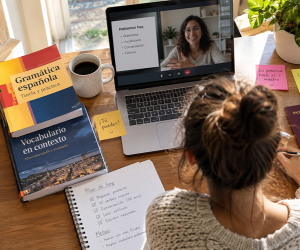
How to Boost Your Spanish Skills Before an Internship

Benefits of Interning Abroad: What the Experience Actually Gives You